

John Walter was a successful entrepreneur and a pioneering figure in Edmonton’s early history. As one of the city’s first millionaires, he played a crucial role in shaping the community we know today. Driven by sharp business instincts, hard work, and a strategic mind, he earned widespread recognition. His contributions to Edmonton’s economy, infrastructure, and business landscape remain an essential part of the region’s heritage. For a detailed biography, fascinating facts, and an in-depth look at how John Walter shaped the city, visit edmontonski.com.
Early Life and the Move to Fort Edmonton
John was born on August 12, 1850, in Scotland, the eldest of William and Helen’s children. His father was a farmer, shipbuilder, and miller who worked three jobs to provide for the family. In 1870, John signed a five-year contract with the Hudson’s Bay Company (HBC) and moved to Fort Edmonton. During his time there, he built York boats for the HBC and used his carpentry skills to help construct some of Edmonton’s early landmarks, such as the McDougall Methodist Church. In 1876, Walter decided not to renew his contract and struck out on his own, earning a living along the banks of the North Saskatchewan River.
By settling on the south bank of the river, he became one of the original residents of what is now Strathcona. His property, Lot 9—which was officially deeded during the 1882 land survey—spanned 155 acres. In his early years there, John built a two-story wooden home and established himself as a shipbuilder, continuing to craft York boats for the HBC, alongside rowboats, barges, dredges, and eventually, steamships.
Building Edmonton’s Economy: Sawmills and River Crossings
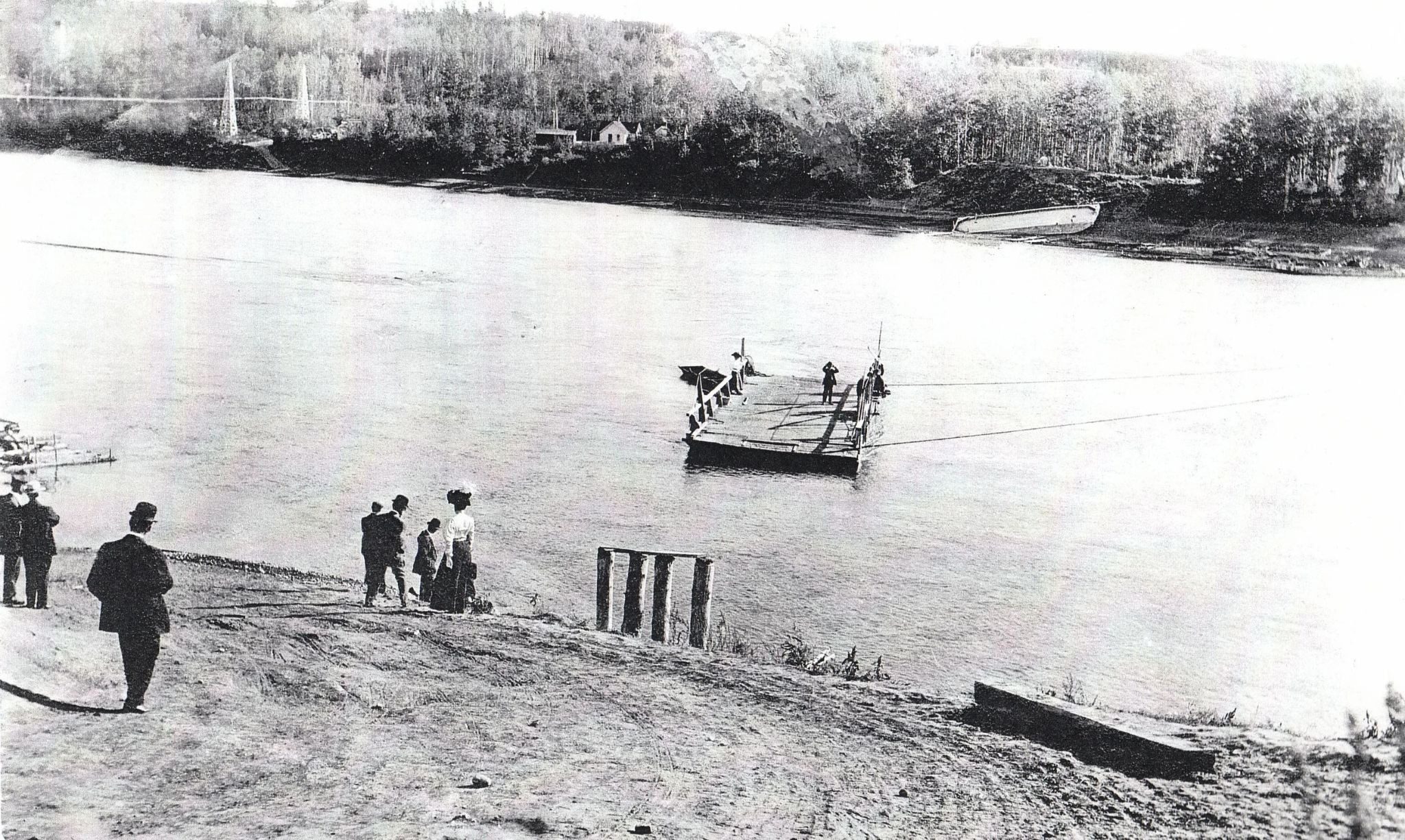
In 1882, Walter launched his most famous venture: a ferry crossing connecting the growing settlements of Edmonton and Strathcona. He purchased the necessary cables in Winnipeg and hauled them across the prairies on ox-carts. The ferry operated on the stretch of the river between today’s 105th Street and the High Level Bridge, moving one wagon and team at a time. It served as a vital artery between the two shores until the High Level Bridge was completed in 1913.
As Walter’s shipbuilding business grew, his workshop—known as Walter’s Flats—expanded to include a blacksmith shop and a carriage-making facility. The success of these ventures, coupled with the rising demand for building materials, led him to open his first sawmill in 1893. At that time, timber was harvested along the North Saskatchewan and floated downstream to his mill. In 1895, Walter purchased a timber limit on Big Island, and by 1896, he was harvesting roughly 300,000 feet of lumber. His lumber business boomed along with the population, supplying materials for many of Edmonton’s early structures. After opening a second sawmill on the north bank in 1901, his enterprises became among the largest employers in the city.
In the early 1900s, Walter’s shops produced two steamships: the Strathcona and the City of Edmonton. Carrying cargo and passengers along a 200-mile stretch of the river, these vessels provided essential links for the early frontier settlements. Walter also offered popular summer excursions on weekends and holidays. These day-long trips to Big Island began with a scenic cruise upriver and concluded with a picnic in the great outdoors.
John Walter’s Legacy: Shaping Strathcona and Edmonton
Beyond his business acumen, Walter had a generous heart and a strong sense of civic duty. He served as one of the first trustees for the South Edmonton School District, helping fund and build the first one-room schoolhouse in 1893. He also sat on the first Strathcona Town Council, served on a hospital board, and participated in the committee that oversaw the amalgamation of Edmonton and Strathcona. He frequently donated lumber to local churches and allowed parishioners to ride his ferry for free on Sundays. As an employer, he was known for his kindness and for never turning away those in need.
In his later years, Walter’s business faced a series of setbacks. In 1907, six people died in a fire at the Strathcona Coal Company, a business he co-owned; the incident affected him deeply. In 1908, a spring freshet burst his lumber boom, washing away logs worth between $50,000 and $100,000. In 1913, a fire destroyed one of his commercial buildings. However, the most devastating blow came with the great flood of 1915. Recorded as the worst in Edmonton’s history, it decimated Walter’s riverside operations. His sawmills were destroyed and his lumber supplies swept away. The entrepreneur never fully recovered from the loss—the same river that had built his fortune had ultimately taken it all away.
John Walter passed away on December 25, 1920. Over the previous decades, he had witnessed the decline of the fur trade, the opening of the Canadian West, and the emergence of a thriving city. Having experienced both great triumphs and profound losses, he left behind a life dedicated to the growth and development of Edmonton.