

Alice Major is an Edmonton-based Canadian writer, poet, and essayist known for her ability to weave scientific thinking with emotive poetry. Her work explores themes of memory, women’s lives, science, and the intricate relationship between humanity and nature. As a founder of the Edmonton Poetry Festival, she has become a key figure in Alberta’s literary scene. In this article on edmontonski.com, we explore her journey and her impact on the country’s contemporary literature.
Her Life Story
Born in Scotland and raised in Toronto, Alice Major eventually moved to Edmonton, where she joined a writing group that launched her poetry career. She grew up in a simple, working-class family, so a career in writing wasn’t an obvious path for her.
Major attended Trinity College at the University of Toronto, earning a bachelor’s degree in English and History. For a time, the future writer worked as a reporter for a weekly newspaper in central British Columbia. In 1981, she relocated to Edmonton and began her career as a freelance writer.
Major’s first book was a young adult fantasy novel. Since then, she has published another 12 books, including a collection of essays on poetry and science. Alice has left her mark on the city not only through her writing but also through her dedicated support of the local writing community.
Alice is a former president of the Writers’ Guild of Alberta and the League of Canadian Poets, and she has also served as chair of the Edmonton Arts Council. She is the founder of the Edmonton Poetry Festival, which is now in its 20th year. In 2017, she received the Lieutenant Governor of Alberta’s Distinguished Artist Award.
On Founding the Festival
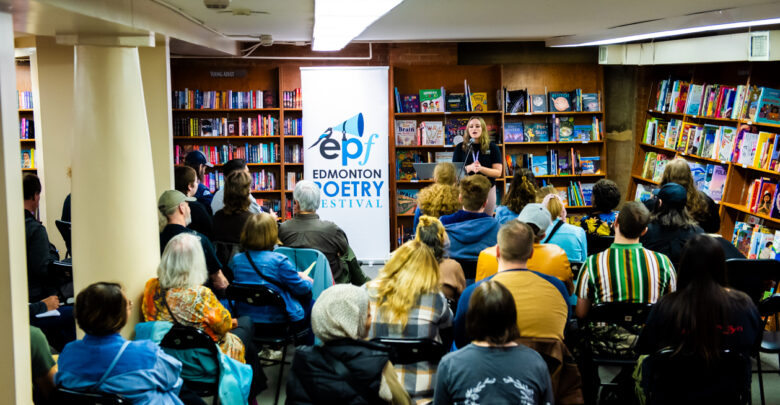
The Edmonton Poetry Festival was founded in 2006 by Alice Major and an organizing committee representing a wide range of the city’s poetry groups, with TELUS as the founding sponsor. Alice envisioned a celebration that would champion poetry in all its forms, aiming to “build bridges through the human voice and the art of language.” The festival became the perfect vehicle for this vision.
The following year, Edmonton was designated a Cultural Capital of Canada. With strong support for all cultural initiatives, the festival ran with ease. The third festival, however, relied heavily on community support and operated on a very small budget, resulting in a more intimate event. This challenge provided the motivation to build a stronger foundation for the future. Major succeeded in securing more stable funding, which was crucial for the festival’s longevity. This demonstrates that Alice is not only a creative force but also a skilled manager.
What Alice Major Writes About
In her work, Alice Major explores patterns, particularly those that scientists uncover in their discoveries about the world. She has said she would love for all scientists to gather and explain to her what the universe is made of. Major is fascinated by cosmology, geology, and the study of the brain, all of which are themes she weaves into her writing.
She creates “sound patterns” in her verses, using language to produce interesting sonic effects. Her poems often merge a scientific perspective with deep emotional experiences. In her essays, she reflects on the role of poetry in modern society and on the writing life. Additionally, Major writes about the experience of being a woman—exploring themes of female invisibility, strength, and the struggle to find a voice in society.
In conclusion, Alice Major not only creates profound worlds of poetry and prose but also actively shapes Edmonton’s cultural landscape. She is a testament to the idea that success in literature doesn’t happen overnight but grows from persistence and a deep love for the written word.